People shuffled in slowly; Children of Nebula set the atmosphere with their artistic beats as audience members admired the artwork displayed across the walls of the room. Carlton Mackey and baby were the DJs for the night.
The pieces were as diverse as the contenders who submitted them for the contest, using a variety of materials. Whether it was thumbtacks, fabrics, or good ol’ fashioned paint, artists had worked on whatever canvas their art desired. The usual suspects were all in attendance, but there were also fresh faces, filled with excitement for a night of performances.
Mariangela Jordan turned in into MC MJ, tapping into her funny bone as she taught the audience the right way to react to the acts she was about to introduce. After we were all educated in the art of applause, Daniel Weingarten opened the show. He closed his set with “Virgin Swag” reminding all of us in the crowd to embrace our quirkiness, so we can walk proud of our virgin swag.
Another frequent presence in Emory’s artistic community, Ariel Wolpe, performed two original songs. Listen Daughters, inspired by Wolpe’s interest in women studies, and Waters of Zion.
The next artist, Anirudh ‘Eka’ Dhullipalla, was introduced by Skyy Walker as one of the “humblest peacocks around”. A theme he reflected in his spoken-word piece, “Graffiti Artist”. He captured the humility behind the anonymity of a graffiti artist, admiring their ability to separate creation from gratification. He asked of the poets in the audience, “would you write your poems the same way if you had to perform them anonymously in front of a mute crowd.” Explaining that, “this is what graffiti artists do naturally, they turn walls into sacrificial altars, leaving passion on concrete canvases without ever wanting the praise of a crowd.”
Like every open mic night at Emory, the night featured a fair-share of cultural performances. Senior Shreyas Sreenath blasted his harmonica for his last performance as an undergraduate at Emory as part of what MC MJ affectionately dubbed “the Indian ensemble”. There were Bollywood songs and Tibetan prayers, reflecting the diverse assortment of art that exists on this campus. Another standout artist was singer Iman Folayan, who spit some sick rhymes over beats that had the audience on their feet.
Children of Nebula closed the show, showcasing the fantastic music that had been the soundtrack for the night. The traditional spontaneous cypher tradition that ends every Ethics Café continued as the Ajibade twins,Joshua Watkins,
and Children of Nebula began to rap over the bands’ banging beats. The cypher also featured Carlton Mackey who used his time on the mic to introduce the winner of the Visual Arts Competition. Grace Chin won for her piece “Vases”.
The third annual Free Speech Ethics and Arts Café showed that the artistic pulse at Emory is as strong as ever. Even as volunteers packed up tables performers and audience member continued to play their instruments, inspiring multiple jam sessions during cleanup. The night was a success; giving the growing artistic community a venue to express themselves openly, showcasing who they are through their art.
Reported by Simran Khosla.
Photos by Munir Meghjani
originally written for Advanced Newswriting and Reporting then republished in The Emory Wheel: Features Section (www.emorywheel.com)
For Emory College senior Shreyas Sreenath, study abroad wasn’t about if he would do it, it was more a question of when. His opportunity came last fall when Sreenath travelled to Kampala, Uganda through one of Emory’s many study abroad programs. While there, Sreenath took classes in a Ugandan university and lived with the people of the Luweero District, researching agrarian development. After three years of studying development in the Emory economics department, Sreenath was finally able to see the real impact of the theories he’d learned in books. He returned from the program fulfilled, having successfully completed his research, with a head full of once-in-a-lifetime memories.
Sreenath’s journey, rewarding as it was, had bitter beginnings. To finance his foreign study, Sreenath applied for the 2009 grant from the Institute for Developing Nations, a merit-based scholarship that required him to write a proposal for research in a developing country. When the results were announced, he received only $2500, half of what he expected.
“They say they cut the funding because it was too much for an undergraduate to get to do research,” Sreenath said, “but I don’t think it’s a coincidence that it happened right after the recession hit.”
Sreenath is one of the lucky ones. As Emory students and their family members struggle to deal with national economic issues, fewer students are able to partake in international programs.
This year marks the lowest study abroad enrollment since 2003 and with the Center for International Programs Abroad’s funding for programs being based entirely on student enrollment, University funding for individual programs has decreased. According to Kristi Hubbard, Director of CIPA, funding sources for CIPA’s travel grants and external funding into CIPA has been steadily decreasing since the recession. Hubbard also notes that when students withdraw from CIPA programs, finances are the most common reason. There has also been an increase in the number of students who qualify for financial aid. “In previous years maybe 25 percent of the students were on financial aid and last year it was 32 percent,” Hubbard said.
As the value of the dollar falls abroad, exchange rates have begun to effect international study programs. Hubbard explained, “You’re looking at the euro, you’re looking at the pound so, depending on the exchange rates, things are maybe less possible than they were in the previous years.” The dollars that Emory students have saved to study abroad are no longer worth as much, making it more expensive for students to travel to foreign countries.
These increased costs have led more students to study abroad during the semester rather than the summer. Since students who are doing foreign study programs during the semester would have paid Emory tuition anyway, shifting locations to abroad costs only slightly more. During the summer, however, students have to explain to parents why they’re spending an extra half-semester worth of tuition. “Summer is more of an add-on type thing. If you’re going abroad over the semester you were going to be at Emory anyways but summer is something special,” Hubbard said. It seems that fewer students have been able to convince their parents that summer programs are special enough, with student enrollment these programs dropping 8 percent this year.
Decreased enrollment for summer programs forces CIPA to make budget cuts. One faculty member who has had to make changes to his summer program due to lower student enrollment is Emory political science professor David Davis. For the past five years Davis has run the European Politics summer program. For its first three years, the program based itself in Paris, with 23-25 students. In 2008, the program moved to Berlin and, last year, had only 16 students enrolled.
Fewer students in the European Politics program gives Davis a smaller budget to work with, forcing many changes to the program. Davis said the majority of these have been related to living costs. When the program was in Paris, the dorms for students were doubles and singles. With the move to Berlin, students lived in triples and quads, lowering the price per a student.
Davis has also been forced to shorten the length of his program. In Paris, the program was six weeks and, last year, Davis reduced it to five weeks. “That turned out to be a little bit overwhelming. We’re still trying to squeeze in the same number of class sessions and site visits,” Davis said.
Davis has also had to make adjustments to the travelling portion of the program. The European Politics program features many visits to neighboring nations. When the program was in Paris, Davis had four different site visits: Geneva, Strasbourg, The Hague and Brussels. This year, Davis omitted the Geneva visit.
“It turns out to be more expensive because there’s no cheap airline that flies from Geneva to Berlin, whereas in Paris we could have just taken trains,” Davis explained.
While staying in Berlin may lower costs for the program, Davis worries about the negative impact as students are getting less exposure to different cultures when travelling abroad.
In addition to making financial changes, Davis has been working hard to recruit more students to increase funding into the program. “I’ve been to more classes, handed out flyers, and been reaching out to other universities to see if they can list our program,” Davis said.
As program directors struggle to fill their programs to avoid more budget cuts, CIPA has been working to make these programs affordable for the entire Emory student body.
“The great thing about how we structure study abroad at Emory is that students are, during the semester, able to take their Financial Aid with them,” Hubbard said, “For a semester students pay Emory tuition here which enables them to keep financial aid and other costs are paid directly abroad”.
Emory’s Financial Aid Office also has many other programs that help students bankroll their international excursions. Students who have been taking advantage of work-study opportunities at Emory are qualified to get an average of their pay for two semesters up to a certain cap. The office also works with students to help increase their eligibility for student loans.
CIPA also has Kenya Casey, a study abroad advisor who helps students manage financial issues. One of her suggestions when students come to her with price problems is to change their location. “Let’s say they really want to go to the U.K., but the U.K. is so expensive,” explains Casey. “My recommendation would be, think about going to a non-traditional location such as Africa, Asia, or something in South or Central America where the cost of living is significantly lower. It may cost you more to go there, but once you’re there it’s not going to cost as much.”
Emory junior Andres Arevalo followed this advice last spring. Arevalo travelled to Freiberg, Germany for his study abroad. Since his scholarship to Emory transferred to pay his study abroad tuition, all Arevalo paid in Germany was room and board and miscellaneous expenses.
“I understand how a lot of people would be like ‘you’re spending a lot of money to go to Europe,’ but my parents understood that it was actually going to be cheaper,” Arevalo said. “So, even in the recession, it was better.”
This strategy worked out so well financially for Arevalo that he plans to study abroad again in Fall 2011 in Rio de Janeiro.
Hubbard maintains that even with the effects of the recession, the study abroad program at Emory will continue to be an essential part of the university’s academic programming. Between 40 to 50 percent of Emory undergraduates do something abroad before they graduate either through semester programs, summer programs, or another international experience, she said.
“Here everybody believes in Study Abroad, faculty, everybody. Everybody weaves it into the academic experience,” Hubbard said, “So it’s not this extra-curricular thing, it’s something that is an integral part.”
Even students like Sreenath, whose experiences with study abroad remained slightly tarnished by financial woes, continue to believe in the transcendental power of travel. After his trip to Uganda, Sreenath turned his research from Luweero into a paper that will be published later this year in a development journal. After graduation, Shreyas plans to continue his international odyssey. He hopes to be travelling to Bangladesh to as a candidate for the Fulbright scholarship.
originally written for The Emory Wheel: Arts & Living(www.emorywheel.com)
Last Thursday, College senior David Micley screened his documentary, “Cousins of Faith,” which depicts the lives of a devout Muslim, Ehab Jaleel, and a devout Jewish man, Kivi Bernhard, both living in Atlanta. Micley gave a brief introduction to an almost packed audience in White Hall 208 before premiering his 30-minute documentary. The screening of the film, which was Micley’s senior project for his Interdisciplinary Studies (IDS) major in society and culture, was followed by a discussion panel between Micley and the two subjects of his film.
Bernhard is a self-employed diamond merchant while Jaleel is the executive director of a charter school in Atlanta. Both men make religion a strong priority in their daily lives. Jaleel discusses the serenity he finds by taking five minutes out of his workday for daily prayer in his office. He also mentions how he hurries from administrative meetings to Friday prayer at his mosque.
Bernhard remains constantly aware of his faith, humorously describing the link between diamonds and divinity in a scene set in his office. “God makes the diamond, we provide the service,” he said.
Micley divided the film into sections, sharing how Jaleel and Bernhard use their religion in their daily lives. Micley focuses mostly on how religion affects the atmosphere in the characters’ homes, and how they share their religious values with their families. The documentary illustrates the way religion permeates all aspects of life. Religion doesn’t exist solely in the Torah or in the Quran; it shapes how a family functions and feels, which is apparent throughout the film.
“I always thought of religion as something that encompasses everything — family, faith and life. Religion is everywhere,” said Micley.
One of the most powerful parts of the documentary is Micley’s juxtaposition of the different prayer practices of the two religions. He provides visuals of both men: Bernhard dons a tallit and tefillin, while Jaleel touches his forehead to the ground.
The scene displays the emphasis on the physicality present in both religions. Bernhard discussed this theme later saying, “It was good for people to see that point of similarity, of [prayer] being a tactile experience”.
Micley balances the more serious subjects in the film with more humorous ones. Whether it was Jaleel’s 9-year-old daughter breaking into giggles in the family prayer room or Bernhard frantically searching the floor of his office after dropping a $70,000 diamond, Micley added moments that made audience members laugh while learning about the lives of the two men. These moments, combined with the plethora of personal familial interaction Micley captures on camera, gives the audience an intimate glimpse of Jaleel and Berhard’s lives.
According to Micley, the process of creating the film was very much improvisational.
“As much as I wanted to tell a story, the story kind of told itself,” said Micley. “It was sort of a negotiation between my vision of the film and what I had to work with.”
The importance of the film being set in an American context is discussed throughout the documentary. Jaleel compares maintaining religion in America to religion in the Muslim countries he’s visited. “It’s a conscious, deliberate act here, and there it’s mostly passive and part of the culture,” he said. “I mean, it’s entering a mosque in Roswell, Ga.”
Bernhard praised the freedom of self-expression present in American society but noted how it can also hinder religious expression. “America offers both sides of the sword,” he said. “It gives you the freedom to [practice your own religion] but all the antagonizing forces too”.
When the documentary concluded, Barbara Patterson of the Department of Religion moderated a discussion panel between Micley, Bernhard and Jaleel.
She asked Bernhard and Jaleel about the experience of being the subjects of a documentary. Bernhard noted how much Micley’s demure disposition influenced the process. “Part of it is David’s personality,” he said. “He’s not a formal person which really helps in this.” This comfort level is clear during the documentary, as both Bernhard and Jaleel seem completely at easy with a camera invading their intimate lives.
Patterson questioned Micley as to why he chose to use film as a medium rather than to write traditional thesis paper. Micley said he found the visual aspect of film appealing: “When you’re looking at someone in real life, you don’t know how long you can look. In film you’re in a dark space and you can just observe,” he said.
Jaleel ended the discussion by emphasizing the core theme of the film. “It’s beneficial for us all to get to know each other better.” he said. “Whatever our faith.”
originally written for The Emory Wheel: Arts & Living(www.emorywheel.com)
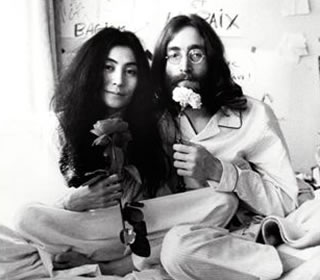
Like most Beatles fans, I find Yoko Ono to be a touchy subject. On the one hand, Yoko’s relationship with John Lennon inspired some of his most memorable pieces, moving him away from traditional pop to the more experimental style that defined the later sounds of the Beatles and his solo work. On the other hand, there’s Revolution 9. Even the most accepting artists will admit that Ono often seems more interested in art for art’s sake, leaving Beatles fans like me craving the days of subtle simplicity.
Even with this interesting dichotomy, fans of the band are quick to pass judgment, frequently faulting Ono for the Beatles break-up. Whatever a Beatles aficionado’s feelings toward her may be, it cannot be denied that Ono was an artist in her own right long before landing a Beatle as a boyfriend.
Film connoisseur Andy Ditzler seems to understand this idea, curating Yoko Ono’s Reality Dreams, a series of screenings of Ono’s films that culminated this weekend in a screening of “Bottoms” in White Hall on Friday.
The film, arguably her most notorious work, left some audience members inspired and others just bored due to its bizarre choice in subject matter.
Yoko Ono’s “Bottoms” is literally just that: 365 professional actors’ and celebrities’ bottoms. Each derrière, filmed while the actor is walking and constantly in motion, is displayed for 15 seconds over the course an 80-minute reel.
This assortment of arses is accompanied by a cheeky soundtrack filled with quotations from the wide-variety of people involved in the project. It features interviews with Yoko Ono, director and then-husband Anthony Cox, the cast who bared their behinds as well as those who rejected the project, deeming it too vulgar or pornographic.
Only Ono could choose the most giggle-inducing part of the human body and turn it into an object on display that loses all of its hilarity, literally turning our butts into serious business.
While in the beginning, the first few displayed derrières caused the audience to giggle, after 60 minutes of watching Bottoms, you no longer see butts.
After a while, the only thing that remains in your mind is the differences between them. The fact that no person filmed walks in the same way and how no two pairs of posteriors are the same. Maybe that’s the message Ono is trying to send, through the interesting medium of our rear ends.
At the same time, 80 minutes is a little bit extreme. Boredom sets in very quickly after the initial message is understood. The film, according to Ditzler, was originally a five-minute, silent short film.
Maybe Ono should have kept it that way, given that after a few minutes the message of “Bottoms” seems to come through. This should be another lesson for Ono, just like Revolution 9, that sometimes the original tends to be more powerful.
originally written for The Emory Wheel: Arts & Living(www.emorywheel.com)
Merry pranksters all over the globe celebrated April Fool’s day on Friday, indulging in the yearly celebration of sanctioned delinquency. Like most worldwide phenomenon in the age of the Internet, the cleverest tricksters showcased their talents online.
As always, Google played a variety of tricks on their devoted users. They unveiled their application for Google Autocompleter, which entailed employees typing autocorrect suggestions as users typed their searches into Google. Requirements for candidates included the ability to type at 32,000 words per minute.
Google also “unveiled” Google Motion, a web-cam enabled enhancement allowing Gmail users to control their accounts entirely through gestures. They accompanied their announcement with hilarious videos showing which motion would correspond to each Gmail action. To send an email, simply lick an imaginary stamp and mime placing the letter in a mailbox.
College senior Omotola Ajibade was one of the many millions who fell for the prank, citing the fact that Gmail was unveiled on April 1, 2004. “I really did think it was real for a second because that’s when they’d announced what’s now the most popular email system in the world,” he said.
Other online giants joined the April Fool’s day parade of pranks. YouTube and Hulu took an “old school” approach. YouTube changed to YouTube 1911, with a “1911 button” that turned every video being watched into a sepia-toned silent movie.
Hulu, which added “brand new” content from the ’90s, changed its display to technology of that decade. It featured black and white scroll bars and used the always-aggravating AOL dial-up noise as viewers waited for videos to load. Also worth a mention is the Huffington Post’s one-day switch to “The Hoffingston Post,” a news website dedicated entirely to chronicling the life of “Baywatch” alum David Hasselhoff.
Company sites all over the web world announced a variety of new “products.” Toshiba unveiled their 3-D monocle, for the movie fans that feel the need to be slightly classier during their 16th viewing of Avatar.
The best contribution from the corporate world, however, came from Virgin Group CEO Sir Richard Branson. The company announced that Branson had purchased Pluto and planned to reinstate it as a planet. An article on Virgin’s website quoted Branson saying, “Virgin has expanded into many territories over the years, but we have never had our own planet before. This could pave the way for a new age in space tourism.”
Here at Emory, we are no strangers to pranks. Our beloved Dooley is frequently dressed in different costumes depending on the upcoming events. A few years ago, Oxford college students placed a zebra, aptly named Barcode, in Emory’s historic Seney Hall.
Yet while the world, particularly the World Wide Web, celebrated this day of childish trickery, campus remained oddly quiet. Dooley remained undressed as usual, no crazy signs or pranks of any kind were visible on campus, with the exception of a prank in the Wheel’s sports section on Friday.
In the wake of Wiz Khalifa and Dooley’s Week, this year’s global fun fest seemed to go almost unnoticed. Most Emory students had to be reminded it was April Fool’s Day and even when they were, didn’t seem too concerned with pulling pranks.
In an effort to keep us from losing touch with this childlike celebration, I offer this piece of advice to all campus-dwellers who forgot this day of lighthearted liberation: Even as we age and tackle the collegiate lifestyle, make sure you don’t forget your inner child. As finals are fast approaching, maybe the best way to retain some semblance of sanity is finding our funny bones again.
originally written for The Emory Wheel: Arts & Living(www.emorywheel.com)
There are certain questions that haunt all Emory students: Do I really need to know how to do a push-up to graduate? Will my mangled corpse be found crushed between shelves in the stacks someday? And, most importantly, who would win in an ultimate battle to the death between Dooley and Swoop? Comedy improv troupe Rathskellar answers all of these questions and more in its newest project, Chips and a Pickle, Baby?.
The performance is a two-act sketch comedy show based on the bizarre happenings that could only exist in the Emory community. The show, which debuted in Harland Cinema this past weekend, will be performed two more times this coming weekend, March 26 and 27 at 8 p.m. The troupe will also be returning to improv later this semester with the Rathskellar Senior Show on April 25 at 8 p.m. in White Hall 208.
While most Emory students and recent graduates know Rathskellar to be an improv troupe, the organization actually has a history of working with sketch comedy. A decade or so ago, Rathskellar was exclusively a sketch troupe.
Reigning Emperor Joshua Izaak had the idea of returning to these early Rathskellar roots, suggesting a shift into sketch comedy last spring. But with certain members abroad and many other commitments within the group, plans were postponed. Last fall, after seeing multiple shows by the comedy troupe The Second City, Rathskellar was inspired to revive the idea, and began planning an Emory-themed show.
The “Skel” fans who are familiar with Rathskellar’s “no-smut” policy will be surprised to find that Chips and a Pickle, Baby? is more daring and unafraid to broach some tabooed topics.
“No one is safe at this show,” said Geoff Schorkopf, Rathskellar High Priest. “Those who keep track of Emory goings-on will be pleasantly surprised at some of the subtler jokes. Yet some of the more outrageous jokes smack you in the face like Dooley’s glove.”
Sophomore Preston Hogue explores the love-hate relationship students have with sustainability. Izaak shows us what happens when Dooley Guards go too far.
Schorkopf aptly imitates certain overenthusiastic Orientation Leaders, and sophomore Jake Krakovsky coins what could be the greatest Dobbs University Center (DUC)-inspired catchphrase Emory has ever seen.
“The transition felt smooth, and none of the comedic value was lost,” said sophomore and diehard Rathskellar fan Jefferson Sporn in reference to the group’s shift into sketch comedy. “The show was fresh and different and still incredibly funny.”
Moving from their typical improvisation into a scripted show was a difficult journey for troupe members.
“Rathskellar was not ready for the process: writing, rehearsing, memorization,” Schorkopf said. “It’s just not what improvisers do.”
The group capitalized on their honed improv skills during the writing process, formulating sketches and coming up with ideas through their natural, spontaneous style.
As the script progressed, the members shifted to a more traditional method of playwriting by dividing into smaller groups to fine-tune individual sketches.
“Whereas most Skel practices are group efforts, we really had to divide and conquer on this one,” Schorkopf said. “After we all would work on different skits, we’d come together, present our stuff and make edits.”
Izaak wrote the majority of the skits but, in true Rathskellar style, every group member contributed something as the process moved along.
“Most of the basic ideas were created at the end of last semester in a mass brainstorm session,” Schorkopf said. “Many skits got added and cut as the semester went on. Sophie [Edwards], Josh [Izaak], Jake [Krakovsky], myself and our excellent pianist, Joel [Thompson], have also developed a number of original songs. I’d say, on the whole, the entire show sounds like it’s coming from a unified voice, which makes it truly a product of teamwork.”
While shifting into the technical world of playwriting was a demanding task, Izaak also notes that it was a necessary learning experience for Rathskellar.
“This has been more of an experiment, and I think the group has responded well to it,” Izaak said. “Everything was more organized. I got both a stage manager, Rebecca Drake, and assistant stage manager, Madeline Teissler, to help with running rehearsals. It’s hard to be everywhere at once and to do every little thing, and they have been fantastic in helping make this show a reality.”
All of these elements came together in Saturday’s show, displaying a different yet equally entertaining side of Rathskellar. Scene breaks were filled with applause from the audience and a piano score by Thompson.
“Rathskellar did a wonderful job, as would be expected from its improv reputation,” junior Malcolm Tariq said. “Hopefully, they will do more sketch shows in the future.”
Even as Rathskellar mocked the Emory Alma Mater, the show seemed to be an effort of love.
The attention to detail when it came to Emory-specific humor was phenomenal and could only be created by true lovers of the campus community.